Essay Robot Software and AI
Digital Twin Platforms for Robot Cell Simulation and Commissioning
Virtual commissioning catches design failures before hardware powers on.
Depending on whether the priority is path verification and cycle-time accuracy, PLC logic and safety interlock testing, or perception and AI policy training, the appropriate choice ranges from OLP-focused simulation tools to a platform with actual controller emulation to Isaac Sim's sensor simulation and ROS 2 bridge. These are the failures that define traditional commissioning: collisions, reachability gaps, and ladder-logic bugs that appear once the hardware is bolted down and the clock on production is already running. The sequence that produces this outcome is old and familiar. Design finishes, the cell gets built, someone wires it, someone else programs it, and only then does anyone find out whether the whole thing actually works together.
The disciplines divide the work in a way that causes the underlying trouble. Mechanical engineers validate the fixture. Controls engineers validate the PLC logic on a bench. Robotics programmers validate the path in isolation.
The industry's response to this is now visible in the money moving toward the problem. The digital twin commissioning cells segment is on track to reach USD 10.2 billion by 2036, growing at a compound annual rate of 19.6 percent. That is the growth curve of an industry-wide shift, not merely a niche tool picked up by a few early adopters. It's the growth curve of an industry deciding that late-stage discovery is a structural defect in how commissioning gets done, and that the fix has to happen earlier, before the hardware ever gets power.
Digital twins versus simulations in a commissioning workflow
A simulation runs once. An engineer builds the model, runs the cycle, checks the result against the print, and moves on. Whatever happens on the floor after that has no way back into the model. That's fine for a pre-deployment sanity check, but it's not what most people mean when they say "digital twin," and treating the terms as interchangeable leads teams to buy a one-shot verification tool when what they actually need is a live one.
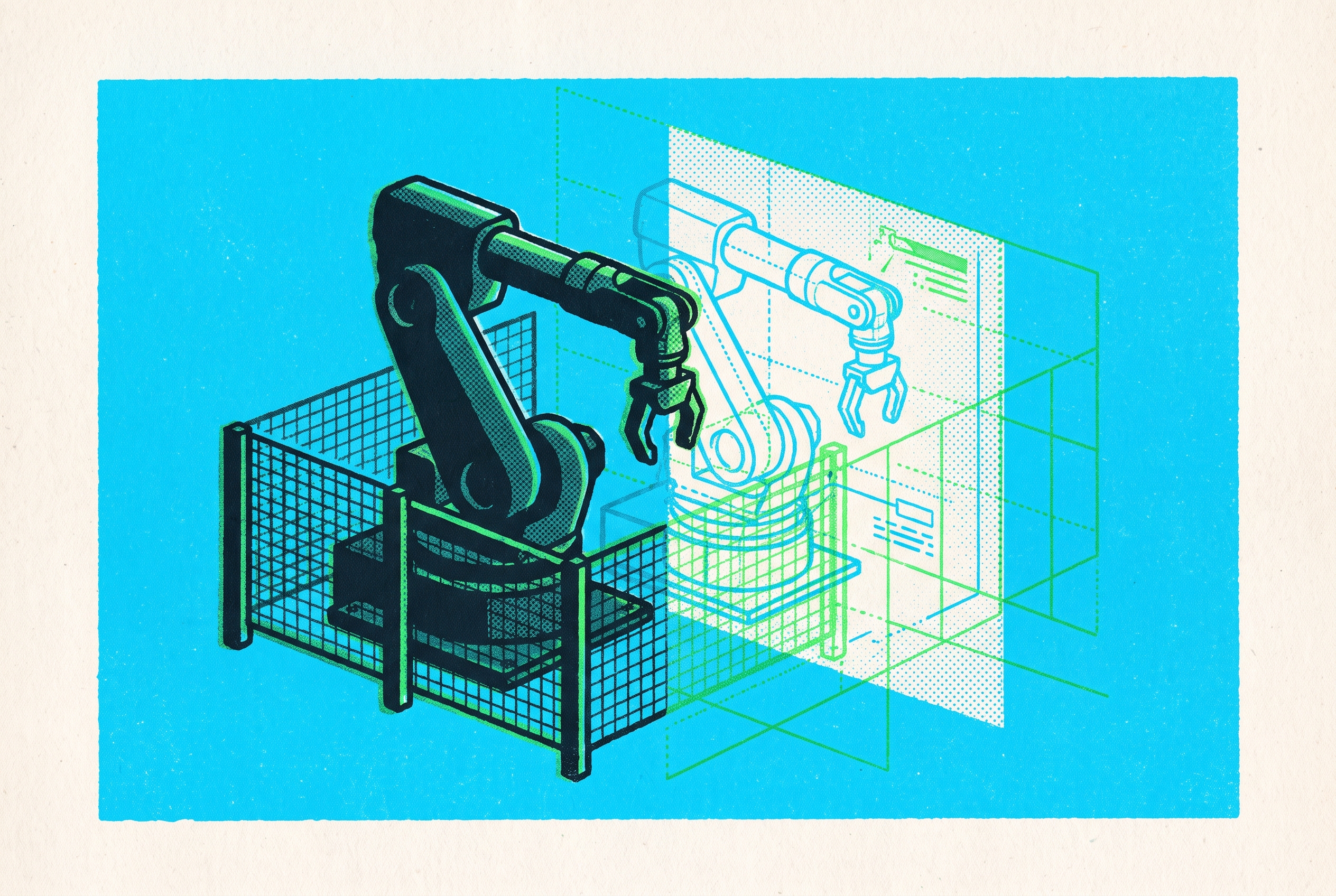
A digital twin keeps a data connection running in both directions. The virtual model doesn't just predict where the robot will be, it reflects where the robot actually is: current joint position, positioner angle, arc parameters if it's a welding cell, whatever sensor readings the controller is producing, updated continuously rather than checked once. Michael Grieves laid out the concept this way at the University of Michigan in the early 2000s, with a physical product in real space, a virtual product in virtual space, and the data link that ties the two together. That third piece, the live link, is the entire distinction. Without it, you have a simulation with good graphics.
The payoff of keeping that link alive is that the twin doesn't retire once the cell goes into production. It keeps earning its cost after go-live by supporting what-if testing on process changes, feeding predictive maintenance models, and closing the loop with the MES. The 2026 robotic welding software stack layers these capabilities: offline programming for path planning, simulation for cycle-time validation, digital twin for real-time parity, and AI teach-free path generation on top. Each layer does a distinct job, and the digital twin never turns off.
The three technical problems virtual commissioning specifically solves
The first is drift. A traditional offline program produces a static path, a fixed set of coordinates the robot is supposed to hit. The physical cell almost never matches that path exactly, because calibration offsets, fixture tolerances, and thermal expansion all pull the real robot away from the static plan the moment power goes on. A program that looked perfect in the office starts missing its marks on the floor for reasons that have nothing to do with the program itself.
The second is accuracy in the inverse kinematics that generate the path. That number stands out. A quarter-millimeter of drift can turn a clean weld into a rejected part; ±0.07 mm is tight enough that an engineer can actually commission against the virtual model rather than treat it as a rough guide.
The third is PLC logic that nobody can test until the cell physically exists. Ladder logic and safety interlocks are, by nature, reactive: they respond to sensor states and motion events that don't exist until there's a moving robot to generate them. Bugs sit invisible in the code until the first time the real cell runs. Virtual commissioning closes this gap by running the actual control program against an emulated controller wired to a physics model of the cell. A Rockwell Automation patent describes this architecture directly: robot twins built by their original vendors get imported into a simulation platform that doesn't care which vendor built them, so engineers can watch coordinated operation across the whole cell without rewriting a single robot program. None of this works without a communication layer that can move all that data without choking. The same 2026 paper describes an OPC UA framework built for exactly this: sorting heterogeneous data types, compressing the node structure, and running bidirectional closed-loop control between the physical robots and their twins. OPC UA turns up again in nearly every platform below, for good reason.
The industry's response to this is now visible in the money moving toward the problem.
How major platforms approach the commissioning workflow
PLC code gets tested through SIMIT, against a digital version of the plant, before any hardware exists to test it on. Among the five vendors with the largest share of the broader digital twin market, Siemens, Dassault Systèmes, Microsoft, Rockwell Automation, and GE Vernova, which together held 17 percent of that market in 2025, Siemens held the largest single-vendor position. The documented payoff appears before a single robot ships: simulating the line ahead of procurement lets manufacturers see that they need fewer robots, or smaller ones, than the original spec called for. Siemens fits best in complex discrete manufacturing, automotive lines especially, where the Siemens controls ecosystem is already the plant standard. Foxconn's Houston facility is the clearest recent example of the stack at scale: engineers used Siemens' digital twin tech stack, developed on NVIDIA Omniverse libraries, to assemble and validate every mechanical, electrical, and plumbing system virtually before construction, then used the Mega NVIDIA Omniverse Blueprint and Isaac Sim to design, simulate, train, and validate AI-powered robot fleets. Dassault Systèmes DELMIA / 3DEXPERIENCE.
The Rockwell patent describes a vendor-agnostic architecture in which vendor-specific robot twins are imported without requiring the designer to rewrite robot programs in a simulation-native format. Rockwell's own reporting on the Emulate3D Factory Test platform, which builds physics-based digital twins at full factory scale, credits it with a substantial lift in project win rates and a reduction in time-to-market measured in months to years. Emulate3D fits best in North American general fabrication and assembly shops running Allen-Bradley controls, particularly where the real bottleneck is PLC logic validation rather than robot path precision. NVIDIA Isaac Sim / Omniverse. Built on Universal Scene Description (USD), it delivers path-traced RTX rendering close to photoreal, a full sensor-simulation suite (RGB, depth, lidar, IMU, contact), a native ROS 2 bridge, and Omniverse Replicator for synthetic data generation with domain randomization.
Among the leading vendors in the physical AI simulation and digital twin for robotics segment, NVIDIA held the leading revenue position among the top four vendors, which collectively dominated 2025 global market revenues. That capability comes with a real infrastructure cost: it requires RTX GPUs, whether GeForce RTX or RTX PRO, on workstations, servers, or in the cloud, with consumer GeForce RTX cards meeting the minimum spec and OVX-class servers available as one optional enterprise tier, and this is a real adoption barrier for retrofits and SMEs. Isaac Sim fits best in robotics-heavy greenfield builds, AI-driven fleets that need sensor simulation for perception training, and any facility where ROS 2 is already the integration standard. It is a discrete-event simulation and digital twin tool that integrates with Studio 5000 PLC logic, running actual PLC ladder code in emulation before physical installation. OPC UA/DA communication allows integration with Siemens PLCs via TIA Portal's OPC server or third-party OPC gateways like Kepware, and adding OPC UA messaging typically adds less than 1ms to PLC scan time.
DELMIA is named among the leading platforms in the physical AI simulation and digital twin for robotics market alongside NVIDIA, Siemens, and Rockwell. It integrates through 3DEXPERIENCE using RESTful APIs and event-driven communication, and it shows up in the 2026 robotic welding software stack as an offline programming option next to RobotStudio and RoboGuide. DELMIA fits best where an enterprise is already running the 3DEXPERIENCE PLM ecosystem, since the real value is a single unbroken data thread from product design through manufacturing simulation. It connects to Siemens Totally Integrated Automation (TIA) Portal and SINUMERIK/SIMATIC controllers over OPC-UA, supporting real-time throughput monitoring, material-flow analysis, and bottleneck detection across entire production lines and individual robot cells. Rockwell Automation Emulate3D.
RoboDK takes the opposite approach: a vendor-neutral offline programming and simulation platform supporting more than 1,400 robots across over 80 manufacturers, covering essentially every major brand on the market. That breadth is the whole pitch. Shops running a mixed fleet, or integrators who serve multiple OEM customers and can't standardize on one company's native software, get a single environment instead of juggling several. RoboDK fits best in job shops and integrator environments where the robots on the floor don't all come from the same manufacturer and nobody wants to commit to one vendor's walled garden. Siemens Tecnomatix / Process Simulate. The virtual commissioning path runs from NX CAD to Tecnomatix simulation to TIA Portal automation to Insights Hub IoT, forming a complete digital thread.
The boundary between simulation and real-time twinning, and the platform convergence happening now
In 2025, simulation platforms held a 38.4 percent share and digital twin environments a 29.1 percent share of revenues in the physical AI simulation and digital twin for robotics segment, treated as distinct purchasing categories. That split is getting harder to justify on the technology itself. Isaac Sim already works as a standalone training environment and as the physics and rendering engine behind a live operational twin, and Siemens offers both modes inside one integrated Tecnomatix stack.
That has a real consequence for anyone buying a platform today. The tool selected for pre-deployment path verification this year may end up running as the live operational twin next year, without anyone changing vendors. Which means the lock-in decision made at procurement carries further than it used to. Five years ago, a simulation license and a digital twin platform were separate purchases with separate lifespans. Increasingly, they're the same purchase, made once.
Matching a platform to the actual commissioning bottleneck
Start with where the market itself is putting its money, because it tells you what the actual bottleneck usually is. Robot Cell Commissioning Twins held 42 percent of the Digital Twin Commissioning Cells market in 2026, and PLC Emulation and Controls Testing was the leading simulation layer at 40 percent share, bought mainly by machine builders. That's a market telling you that controls testing is the center of the problem, not robot path accuracy on its own.
From there, the decision runs through a short set of questions rather than a scorecard. What controls ecosystem is already on the plant floor? An Allen-Bradley shop gets a straighter line to value from Emulate3D's native Studio 5000 integration, while a Siemens TIA Portal shop gets there faster through Tecnomatix's direct OPC-UA connection. What does the robot fleet actually look like? A single-OEM fleet can lean on that vendor's own tool, RobotStudio for ABB, RoboGuide for FANUC, MotoSim for Yaskawa, KUKA Sim for KUKA, while a mixed fleet or a multi-integrator shop gets more mileage from a vendor-neutral platform with a wide robot library.
What actually needs validating? Pure path verification and cycle-time checks can often be handled by an OLP-focused tool on its own. If the real risk lives in PLC logic and safety interlocks, nothing substitutes for a platform running actual controller emulation. If the scope includes perception and AI policy training, Isaac Sim's sensor simulation and ROS 2 bridge become differentiators. And what infrastructure is actually sitting in the building? Isaac Sim's RTX GPU requirement is a genuine obstacle for a brownfield retrofit with no budget line for new hardware, while Emulate3D and Tecnomatix run fine on the engineering workstations most shops already have, and RoboDK stays within reach of smaller operations that were never going to stand up an enterprise PLM environment in the first place.
Greenfield and brownfield projects tend to land in different places for a reason that has nothing to do with brand preference. A greenfield line commissioning from scratch can absorb the upfront cost of building a full virtual model and get the most out of it, while a brownfield retrofit usually needs a narrower tool that talks to the PLC code already running, without forcing a full rebuild of the cell inside a virtual environment just to test one change.
None of this matters, though, if the link goes one way. A twin that gets built for commissioning and then never hears from the physical cell again is a simulation that took longer to build, whatever the license says. It's a simulation that took longer to build. The platform choice is real and it's worth the analysis above, but underneath it the physical cell has to keep talking back to its virtual model long after go-live, or the investment quietly degrades into exactly the one-time check this whole shift was meant to replace.
Notes
- Robotic Welding Software: OLP, Simulation, Digital Twin 2026
Provided the layered description of the 2026 robotic welding software stack covering OLP, simulation, digital twin, and AI teach-free path generation.
- NVIDIA Isaac Sim: Enabling Scalable, GPU-Accelerated Simulation for Robotics
Provided details on NVIDIA Isaac Sim's capabilities including USD-based rendering, sensor simulation suite, ROS 2 bridge, and Omniverse Replicator for synthetic data generation.
- Digital Twin Commissioning Cells Market to Reach USD 10.2 Billion by 2036, Driven by Virtual Validation and Industrial Automation
Provided the market figures cited for the digital twin commissioning cells segment, including the USD 10.2 billion projection, 19.6 percent CAGR, and the 42 percent and 40 percent segment share figures.
- Digital Twin Market Size & Share | Forecast Report 2026-2034
Provided the figure that the five largest digital twin market vendors collectively held 17 percent of market share in 2025, with Siemens holding the largest single-vendor position.
- Internet of Things-Cloud Control of a Robotic Cell Based on Inverse Kinematics, Hardware-in-the-Loop, Digital Twin, and Industry 4.0/5.0
Provided details on the OPC UA framework for bidirectional closed-loop control between physical robots and their digital twins, including data type handling and node compression.
- How Digital Twins and OLP Software Reduce the Time, Cost and Risk of Robotic Machining Projects | ManufacturingTomorrow
Provided the figure that RoboDK supports more than 1,400 robots across over 80 manufacturers.
- Robotic digital twin control with industrial context simulation
Provided the description of Rockwell Automation's vendor-agnostic patent architecture in which vendor-specific robot twins are imported into a simulation platform without requiring rewriting of robot programs.
- NVIDIA and Global Robotics Leaders Take Physical AI to the Real World | NVIDIA Newsroom
Provided details on Foxconn's Houston facility using Siemens digital twin tech and NVIDIA Omniverse/Isaac Sim to validate systems virtually before construction.