Agricultural Robot Performance in Row Crop vs. Specialty Crop Settings
Plant predictability, not crop type alone, determines where agricultural robots succeed or fail.
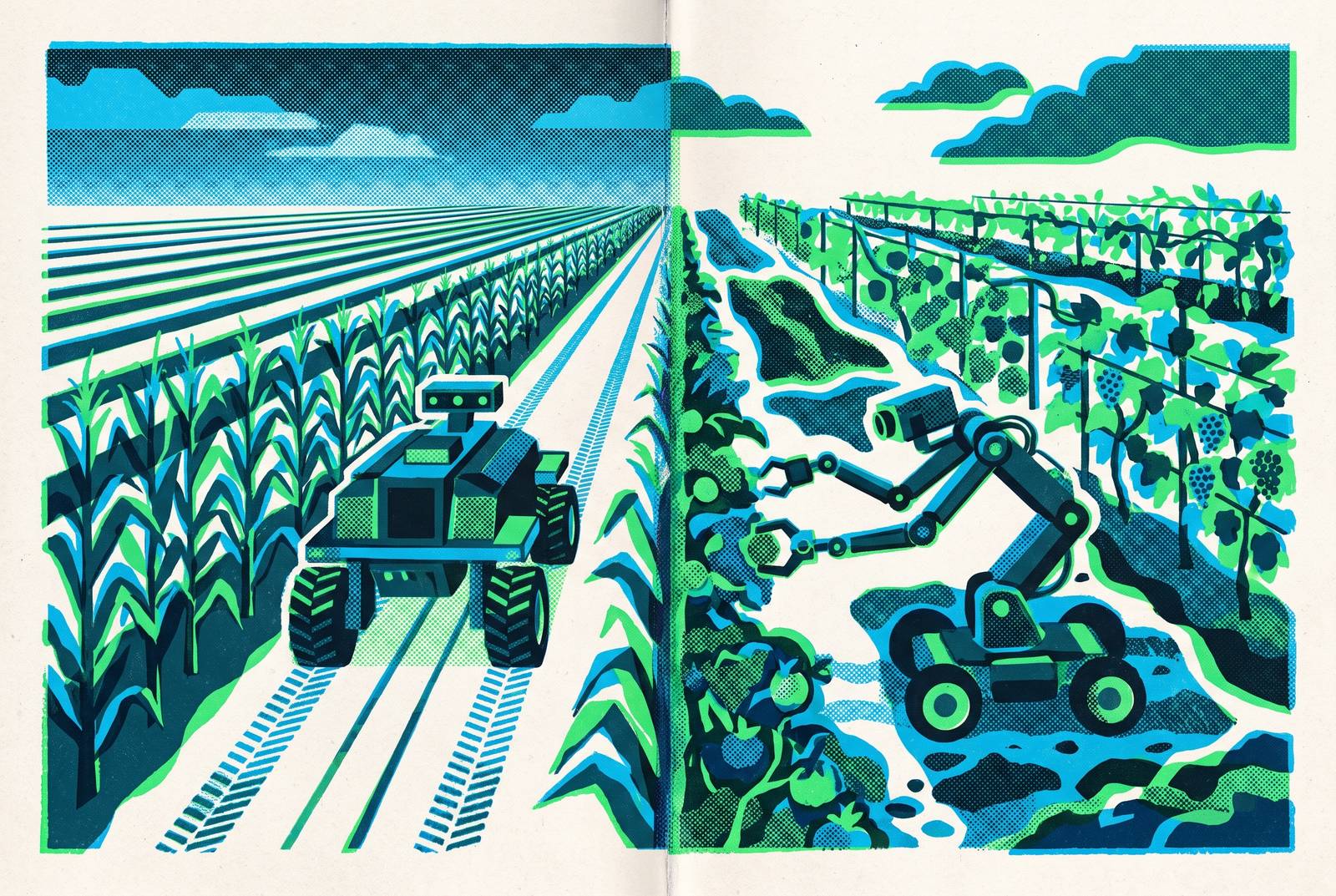
Agricultural robots do not perform as one category of technology. A weeding robot threading soybean rows and a picking arm working an apple orchard face such different problems that comparing their success rates tells you almost nothing useful. The gap between them comes down to one variable: how predictable the plant is, geometrically and physically, when the machine has to find it, move toward it, and act on it. Row crops reward that predictability. Specialty crops punish it, and no amount of clever software fully closes the distance.
Why agricultural robots perform so differently across crop types
The field spans autonomous tillage tractors, precision sprayers, weeding platforms that thread between crop rows, harvesting arms with grippers built to touch fruit without ruining it, drones flying spray patterns overhead, and enclosed systems built to work inside a greenhouse. Treating all of this as one industry hides the real split, which runs between large-scale row crops (corn, wheat, soybeans) and specialty crops (berries, tree fruit, grapes, mushrooms, greenhouse vegetables).
Row crops hand a robot a kind of gift: uniform plant spacing, flat ground, rows laid out in straight corridors, open sky for GPS reception. Specialty crops offer almost none of that. Fruit is soft, it changes shape and color across a season, and it often hides behind leaves at the exact moment a camera needs a clear view. Uneven orchard floors, light that shifts with cloud cover and canopy shadow, and surfaces that make a robot's wheels slip or its arm shake all punish the same sensing and navigation tricks that work fine in a soybean field. Anyone comparing adoption rates across crop types without accounting for this is comparing the wrong thing, and most of the industry commentary on why specialty crops lag simply skips this step.
Where investment is concentrating in the market
The global agricultural robots market stood at USD 15.2 billion in 2025, with forecasts putting it at USD 41.3 billion by 2031. Where the money goes says more than the topline number. Drones and UAVs led the market with a 36.0% revenue share in 2025, largely because aerial spraying and scouting sidestep the hardest problems in ground robotics: wheels, grip, contact with soft produce.
Harvesting and picking robots are the fastest-growing segment, and that is the strange part. Harvesting is also the segment with the hardest technical problem left to solve. Capital is chasing the payoff of automating the most labor-intensive task in specialty agriculture, even as that task sits closest to the edge of what these machines can currently do well. Fast money is aimed at slow-to-mature technology. Anyone expecting near-term returns from harvesting robots specifically, as opposed to spraying or scouting, is betting against the engineering timeline, not with it.
What makes row crop environments tractable for autonomous systems
Structured row geometry is the single biggest reason row crop automation moved faster than specialty crop automation. Uniform plant spacing and predictable inter-row corridors turn navigation into a problem ordinary path-planning algorithms can solve, and flat, open fields give RTK-GPS and computer vision systems a clean signal and a clear line of sight. None of this makes the underlying engineering trivial. Getting a robot to navigate between crop rows during weeding or harvesting, at working speed, without damaging the plants, is still a hard problem. But it's an easier problem than what an unordered orchard or a sprawling vineyard presents, where no two trees or vines sit in quite the same place or grow into quite the same shape.
That gap appears in the research record itself. Row crops such as corn, soybean, wheat, and sugar beet are where automated navigation for weeding robots got solved earliest, and the research literature reflects that head start. That freed researchers to spend their time refining accuracy instead of fighting the basic problem of getting the robot down the row.
Row crop robots currently operating at commercial scale
John Deere took the incumbent's path: build autonomy into machinery farmers already own and trust, instead of launching a standalone robot from scratch. The 2026 model year brings the Next Generation Perception System for Autonomous Tillage, letting select 9R, 9RX, 8R, and 8RX tractors run without a driver in the seat. It ships as a Precision Upgrade kit for 9R and 9RX tractors from model year 2022 onward, and 8R and 8RX tractors from model year 2020.5 onward. Several implements, including the CC Series Coulter Chisel, the 2430 Chisel Plow, the 2230FH Field Cultivator, HSD Series High-Speed Disks, and the 2660VT Variable Intensity Tillage tool, now ship with Autonomy Ready components built in. The 8R's autonomous system runs six pairs of stereo cameras for 360-degree obstacle detection, feeding each image through a neural network that classifies every pixel in about 100 milliseconds and decides, directly, whether the machine keeps moving or stops. Deere has said the plan is to push autonomy from tillage into planting and, eventually, harvest.
FarmDroid went the other direction with its FD20, a solar-powered robot built specifically for row crop seeding and weeding instead of adapted from a general-purpose tractor. It uses RTK GPS to record each seed's exact position at planting, then comes back later in the season to weed both between and within rows using that stored map. At 1,050 kg, it does less damage to soil structure during weeding than a conventional setup pairing a 7,500 kg tractor with a 2,080 kg inter-row cultivator, for the simple reason that it weighs a fraction as much. The company raised €10.5 million in October 2024 for international expansion. Lightweight, task-specific robots have their own commercial momentum, separate from whatever the big equipment makers are doing, and FarmDroid's funding round is the clearest sign of it.
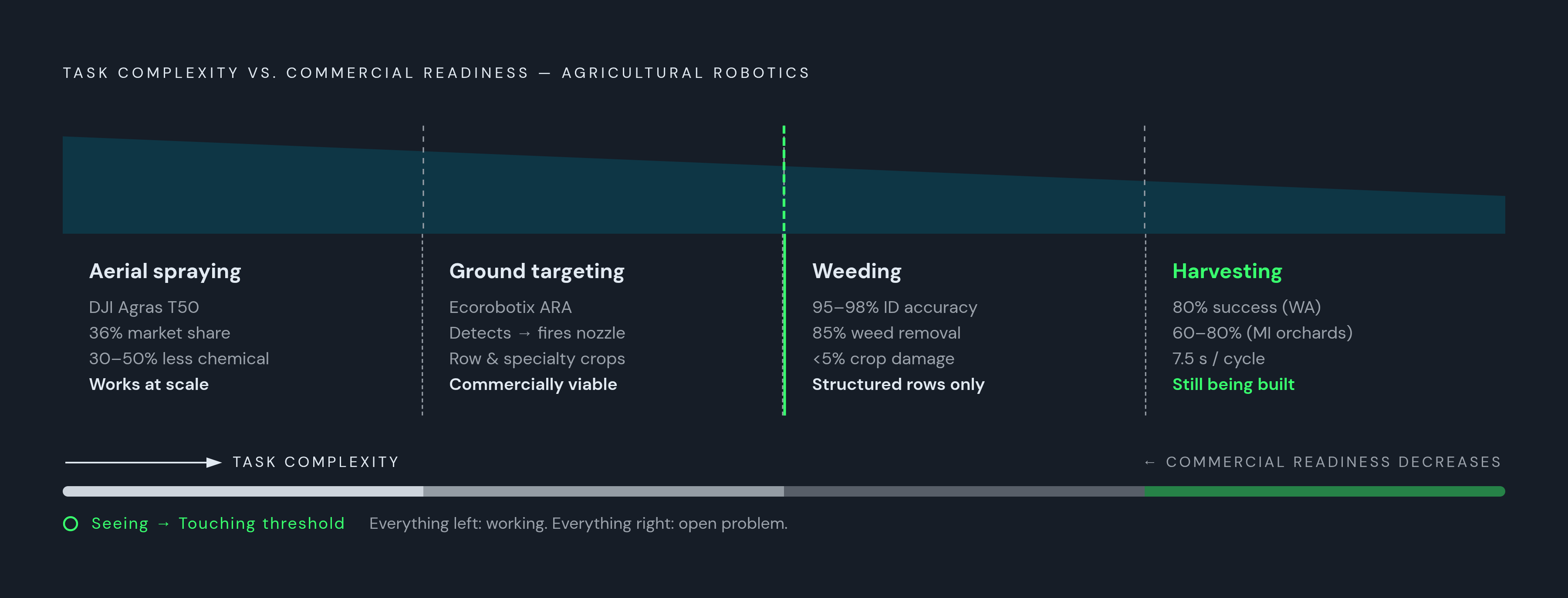
On accuracy, one mixed-autonomous weeding platform tested in open field conditions identified crops and weeds correctly more than 95% of the time, rising to 98% when the system had access to expected plant spacing. The robot removed 85% of weeds while damaging less than 5% of the crop. DJI's Agras T50 carries a 40 kg payload across a 21-meter spray width using RTK precision, and by targeting only affected areas instead of blanket-spraying a field, it cuts chemical use by 30 to 50% against broadcast application, on machines already shipping and running today. These are not lab numbers.
Why specialty crop environments are fundamentally harder for robots
Every advantage row crops offer disappears in a strawberry field or an apple orchard. Fruit deforms, and it changes size, color, and firmness across the season, and it hides behind leaves in ways that block a camera at exactly the moment the robot needs to see clearly. Light shifts constantly with time of day, weather, and canopy density, so a vision system trained on one lighting condition can fail outright under another. Orchard and vineyard ground brings its own trouble: slip, sinkage, and vibration all degrade the precision of the robot's movement and the stability of its sensors. Older orchards make this worse still, since row geometry is often inconsistent or missing entirely, with tree shape and spacing varying tree to tree.
Reliable autonomy under vegetation occlusion, uneven terrain, shifting light, and unreliable field communications remains an open research problem, not a solved one waiting on better hardware. Robot control in these settings has to satisfy accuracy, real-time response, and safety all at once, under conditions that stay dynamic and unstructured by nature. There is no clean way to split that into separate, simpler sub-problems the way row crop navigation allows.
Grasping is the hardest piece of all. Specialty produce bruises easily, and bruising destroys value almost instantly: a strawberry bruised during picking has a shelf life measured in hours, not days. A robotic gripper has almost no room for error on force or angle of approach, and that is the wall row crop robotics never had to climb.
Specialty crop robot performance: what field trials and deployments show
Real numbers back up how much harder this environment is. A dual-arm apple harvesting platform, tested across 1,738 arm cycles in commercial Washington State orchards during the 2025 season, hit an 80.0% per-attempt success rate with a mean cycle time of 7.53 seconds per arm. Perception challenges in dense canopy conditions were a central difficulty, as the trial environment presented the kinds of occlusion and localization demands that field trials consistently identify as limiting factors for harvesting robots. In Michigan orchards, where tree structure is far less uniform, picking rates fell to 60 to 80%. That gap is the plainest evidence available that orchard structure, not software quality, drives the outcome. A grower running a well-trained, evenly spaced canopy gets meaningfully better results from the identical robot than one working older, irregular trees, and getting the orchard itself into shape counts as half the engineering work here, not a footnote to it.
Strawberries and other soft berries lead specialty crop adoption. Systems such as Harvest CROO's platform pick at 4 to 8 flats per hour, modest next to a human picker's peak speed. But robots make up ground by running roughly 20 hours a day. Human pickers get tired, need breaks, and work fixed shifts. A robot doesn't, and that difference changes the underlying economics even when hourly throughput trails a person's best output.
Mushroom harvesting sits in a category of its own, because growing mushrooms indoors removes most of the variability that plagues orchard and vineyard robots. Controlled temperature, controlled lighting, no weather to account for: mushrooms are about as tractable as specialty crop automation gets. 4AG Robotics raised CAD 40 million, about USD 29 million, in Series B funding in July 2025 to expand deployment of its autonomous mushroom-harvesting robots globally.
Vineyards make a different case for robotics investment: labor cost, not technical tractability. Wine grape production carries labor costs that eat up a substantial share of total expense, and the seasonal, physically demanding nature of the work makes staffing harder every year. That mix of high value per acre and chronic labor strain justifies robotics investment even where the terrain stays difficult. Monarch's MK-V, a fully electric, driver-optional machine priced at $78,000, is built for exactly this setting.
Precision spraying as a technology that bridges both settings
Spraying sits in a different category from harvesting or weeding, because it targets an input, herbicide or pesticide applied to a plant, rather than manipulating the plant or fruit itself. That distinction decides how failures play out. A spraying robot that misidentifies a plant wastes a bit of chemical. A harvesting robot that misidentifies a piece of fruit either damages it or fails to pick it, and both outcomes cost real money.
Ecorobotix's ARA sprayer shows what that looks like in practice. Deployed across vegetable fields and row crop farms in multiple settings, targeted spraying systems of this kind aim to cut herbicide drift and total input use substantially compared to broadcast application. The detail that matters here is that sensing-based targeting of this kind can operate across both row crop and specialty crop settings. Sensing-based targeting travels across environments far more easily than manipulation tasks do. DJI's Agras T50 shows the same pattern from the air, cutting chemical use by 30 to 50% against broadcast spraying while working mostly in open row crop and orchard settings.
Spraying bridges the gap because of what happens after the robot spots its target, or rather, what doesn't happen. Detecting a weed or a plant well enough to fire a nozzle is a real sensing problem, but it stops there. Detecting a piece of fruit, localizing it precisely enough to move an arm toward it, then closing a gripper around it without bruising the surface, stacks an entire layer of mechanical difficulty on top that spraying never has to face. That's the line running through this whole comparison. Wherever a robot's job stops at seeing and deciding, the technology already works at commercial scale. Wherever the job demands touching something soft and getting it right on the first try, the industry is still building toward it, and pretending otherwise only sets growers up for disappointment.