
Essay Robotics Industry News
Chinese Humanoid Robot Manufacturers Competing Globally
State backing and supply chains give China's robot makers volume, but not yet autonomy.
China’s humanoid robot manufacturers compete around the world with help from state industrial policy, closely linked supply chains and low prices. Those advantages explain their rapid rise to majority supplier, but they do not establish a lead in useful autonomy. What happens next depends on whether building robots at scale leads to enough real-world learning to close the capability gap.
How China went from latecomer to majority supplier in roughly five years
China reached its position as the supplier of the large majority of humanoid robots shipped globally in roughly five years, starting from the first policy designations in the 14th Five-Year Plan in 2021. IDC data places nine of the top ten humanoid robot vendors by shipments in China. That concentration makes the rise more than the success of a single manufacturer.
Omdia analysts call this pattern “the EV playbook.” Early state backing supports many entrants, which then scale rapidly and capture global share. The comparison is useful because it directs attention away from individual demonstrations and toward the machinery of industrial expansion. Shipment leadership is the result that needs explaining while the technical race remains open. Its speed raises the central question of how China made humanoid hardware available at a scale that competitors have yet to match.
State industrial policy as the structural foundation China built on
Before there was a large market for these robots, the government brought manufacturers together and gave them shared goals to invest toward. In 2025, MIIT and five other ministries jointly issued the Humanoid Robot Action Plan. It set a national target of 100,000 humanoid robots deployed by 2027 and called for a complete domestic supply chain for humanoid components. The policy therefore addressed both demand for finished robots and the industrial base needed to build them.
MIIT extended that coordination in November 2025 by establishing the National Humanoid Robot Standardization Technical Committee. Unitree founder Wang Xingxing and AgiBot co-founder Peng Zhihui were named as vice chairmen, with defense industry representatives also participating. That composition connects commercial development, standardization and the defense-industrial base within the same policy apparatus. A company acting on its own cannot bring a whole country together this way through choices about where to invest.
The supply chain integration that makes Chinese cost advantages self-reinforcing
Policy provides direction, but the component ecosystem makes the manufacturing advantage concrete. The Yangtze River Delta concentrates suppliers whose proximity supports humanoid production. Unitree manufactures motors, reducers and sensors in-house, while suppliers including DJI and EV actuator makers sit within a roughly two-hour logistics radius of its facilities. Vertical integration is therefore a feature of the wider ecosystem.
That combination matters because a robot’s price depends on more than the design of its finished body. Motors, reducers and actuators are part of the component base that manufacturers must bring together repeatedly as production grows. Geographic and supplier relationships are harder to reproduce quickly than a single capital investment. They also give manufacturing volume a route to lower costs that policy support alone would not provide. The structural advantage lies in the system of production.
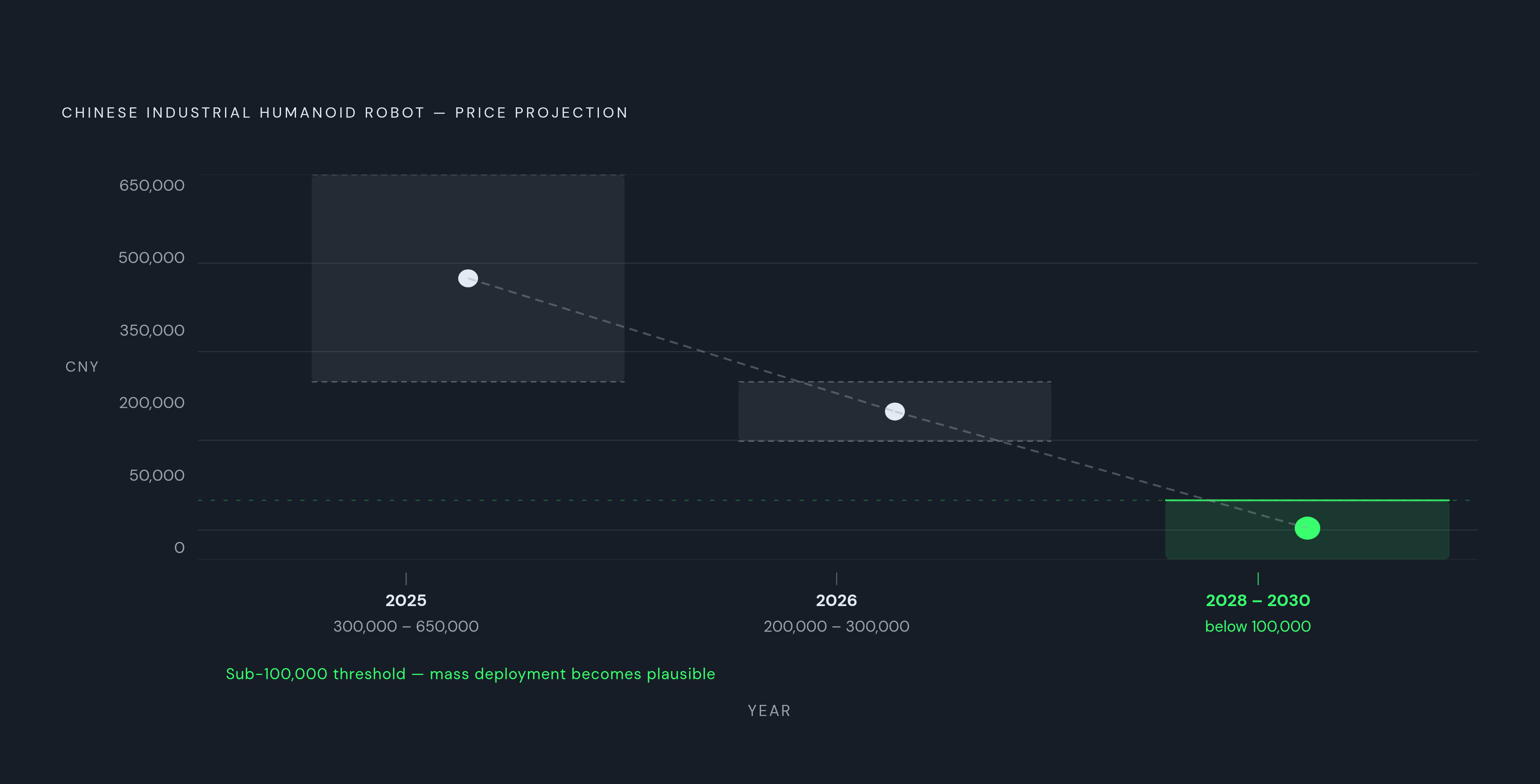
Tianxia Gongchang Research places industrial humanoid prices in the range of CNY 300,000–650,000 in 2025. It gives a 2026 target of CNY 200,000–300,000 and projects a fall below CNY 100,000 by 2028–2030. Even so, the projected curve shows why production scale matters to the competitive argument. Lower hardware costs could broaden deployment, which would give manufacturers more volume over which to develop their production base.
The leading Chinese manufacturers: what they ship, where they deploy, and how fast they scale
AgiBot and Unitree give this structural argument its clearest commercial expression because both have moved from prototypes into batch delivery. AgiBot released the GO-1 embodied AI model covering its Expedition A2 and Lingxi X1 product lines. Unitree’s in-house component production illustrates the manufacturing side of the same competition. Their importance rests on the combination of product development and delivery scale.
UBTech provides named examples of where Chinese humanoids are being put to work. Its Walker S1 is deployed in BYD, Zeekr and Geely factories, while Walker S2 is operating at a border crossing. These settings establish a more concrete commercial footing than an unspecified claim of industrial readiness. They also delimit the evidence, because deployment in a structured setting does not establish general-purpose autonomy.
XPENG Robotics is approaching the market through the automotive industry. Its IRON robot draws on XPENG’s automotive AI and manufacturing scale, with mass production expected in 2026. RCSV Research’s April 2026 analysis states that Unitree and AgiBot alone target more than 75,000 units of annual capacity, exceeding the entire projected Western supply combined. Capacity targets are not shipments, but their scale shows the production ambition Western competitors face.
The comparison is useful because it directs attention away from individual demonstrations and toward the machinery of industrial expansion.
Where Western competitors actually stand and what the US import ban means for the competitive split
Western manufacturers have genuine deployment achievements, even though they are not matching Chinese shipment volume. Agility Robotics’ Digit has Tier 1 verified deployment status and is moving totes in GXO logistics. Agility publishes no purchase price and sells by quote only, which limits direct price comparisons. Figure 02’s work with an automaker also provides a concrete industrial use case. These examples support a competition based on application performance rather than a simple division between manufacturers that deliver and those that do not.
Apptronik’s Apollo occupies a different stage of that progression. It is classified as Tier 2, a named customer trial, on the Humanoid Reality Index and entered Mercedes-Benz’s Berlin Digital Factory Campus. Tesla CEO Elon Musk has warned investors that China’s restrictions on rare earth magnet exports will delay Optimus development, showing how reliance on a supply chain can affect both the time it takes to develop a robot and the cost of each unit.
The FCC import ban of July 29, 2026 also sets rules on where these manufacturers can compete. It applies to new versions of imports rather than units already in use, while its full effect on specific suppliers remains undetermined. Beijing accused the US of protectionism. The resulting split directs Chinese volume toward domestic mandates and non-US markets, while Western firms compete in a protected but smaller home market. That split ties competition based on volume and competition based on capability more closely to different markets, while leaving open which approach will win around the world.
The real constraint: why shipping more robots has not yet solved the capability problem
Shipment volume measures hardware leaving manufacturers. Smart Analytics Global/TASS data shows that Chinese humanoid robots work at roughly 30–50% of human efficiency in industrial settings. That gap bears directly on the case for labor cost savings. A lower purchase price cannot by itself establish economic value if the robot cannot perform the required work effectively.
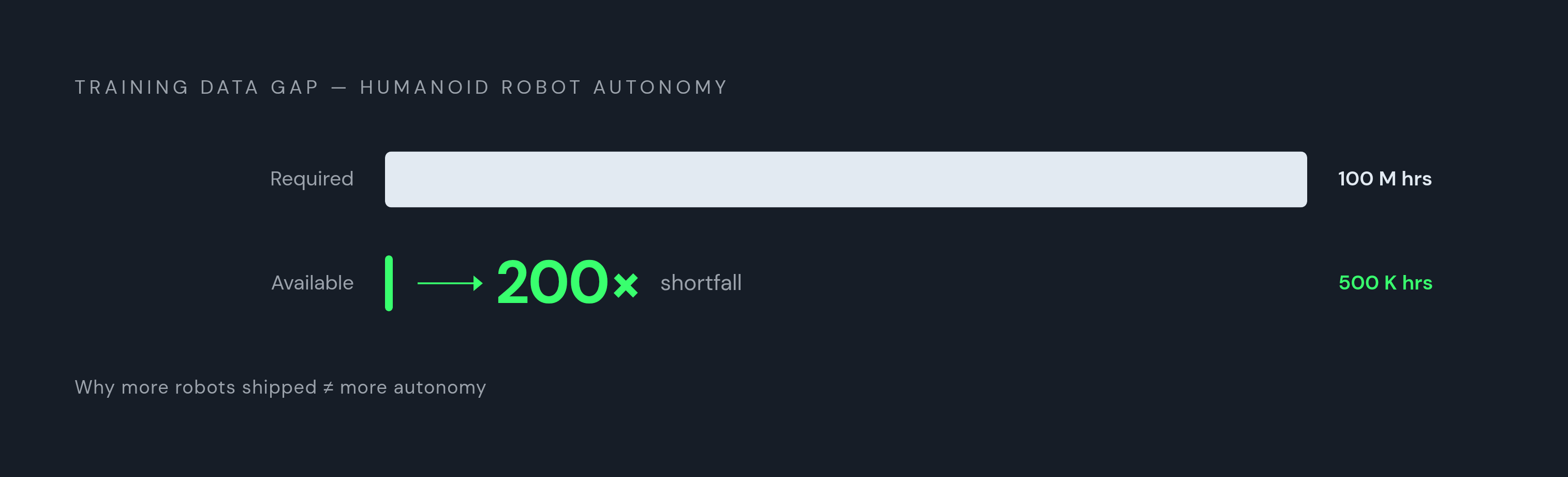
The central limitation is AI. The sector has roughly 500,000 hours of high-quality training data, but it needs roughly 100 million hours to develop robust physical intelligence, a gap of approximately 200x. This helps explain why the industry can get better at building robot bodies faster than it can get those bodies to act reliably. Expanding production and solving physical intelligence are related tasks, but they are not interchangeable.
MERICS found in 2026 that impressive demonstrations are “misleading as the robots are seldom acting autonomously in real time, but either preprogrammed or teleoperated.” Dancing, kickboxing and dexterous performances consequently offer limited evidence of general-purpose intelligence. Commercial value depends on performing useful work under the conditions customers require. Tianxia Gongchang Research’s June 2026 analysis states the divide plainly. “China's structural advantage lies in cost and supply chain, not model capability. The US leads China by roughly 12–18 months on foundation model capability.”
Why China's volume lead creates a compounding data advantage that could close the AI gap over time
Deployment scale offers a credible way to narrow the capability gap. Robots operating in real-world environments generate proprioceptive and task-execution data that can improve the next model’s physical intelligence. Constrained or heavily supervised deployments can therefore contribute learning even when they fall short of independent industrial performance. With more robots in use, China has more chances to gather that experience than it would through laboratory testing alone. This is the strongest connection between its current manufacturing advantage and a possible future AI advantage.
With the release of Isaac GR00T N1 at GTC 2025, NVIDIA added an open foundation model to that process. Open models can accelerate embodied AI development globally, so their availability is not an exclusive Chinese advantage. The distinction comes from the amount of hardware available to generate fine-tuning data. Manufacturers with more robots in the field are positioned to produce more of that data.
That feedback loop does not guarantee that China will close the AI gap. The shortage concerns high-quality training data, so unit counts alone cannot establish that the required learning is taking place. Nevertheless, as models become more open, data may become a tighter constraint than access to model architecture. A deployment base can then compound an advantage that research spending alone cannot easily reproduce. The race remains unsettled, but its terms are shifting from who has the best prototype to who generates the most learning.
The market structure ahead: cost curves, a coming shakeout, and where the application race goes next
China’s many entrants and rapid capacity expansion point toward a domestic shakeout as useful applications become the test of survival. Falling hardware prices strengthen the case for adoption, but they do not remove the capability threshold. Manufacturers will still need applications in which the available autonomy is sufficient for the task. The relevant market is therefore not humanoid robots in the abstract, but the sequence of environments in which they become useful.
Tianxia Gongchang Research sets out a four-tier application path that begins with factory fixed workstations, moves through warehouse logistics and commercial services, and ends with home services. It identifies automotive and electronics factories and warehouse logistics as the core battlegrounds for 2026–2028. It also places a scale market for home services no earlier than 2030. The named deployments already discussed fit this sequence because they center on structured environments and defined tasks.
The protected US market could give Western manufacturers room to deepen their AI advantage, or it could delay exposure to lower-priced competitors. How much that protection matters depends in part on whether those companies can compete outside their home market once the ban’s full effect becomes clear. China, meanwhile, goes into the next phase with well-established advantages in component localization, the cost of making robots and the amount of training data gathered in real scenarios. The actual race is not China against the West in total, but which structural advantage proves decisive in which application tier, and on what timeline.