Essay Robotics Industry News
Robotics Acquisitions and Consolidation Trends
The industry is consolidating around full-stack platforms rather than point solutions.
Robotics M&A has entered a different phase of its history, and the deals closing in 2025 and 2026 are not a faster version of what came before. For years, the winning strategy in robotics was narrow: a company picked one hard problem, whether navigation, grasping, perception, or fleet coordination, and built a product around solving that one problem better than anyone else. That approach rewarded depth. A startup could raise capital, hire a tight team of specialists, and sell a single capability into a market hungry for any automation gain. That era is ending because the business model built on top of the underlying technology has run out of room to grow.
The growth dividend from mastering one capability is drying up. Competition within each narrow segment, whether mobile robot navigation, bin-picking, or warehouse perception, has turned those categories into commodities, and commoditization makes it nearly impossible to win on a single feature anymore. Customers no longer want to stitch together five vendors just to automate one warehouse floor. They want a system that handles the whole workflow, from the moment a pallet arrives to the moment an order ships, and no single-capability vendor can promise that by itself. CMRA's mid-2026 analysis names this condition directly: the only path left to a breakthrough runs through horizontal and vertical supply chain integration, and through building a full ecosystem.
Reshoring adds pressure on top of this. Manufacturing executives are putting a meaningful share of their 2026 improvement budgets into smart manufacturing, and they want a complete answer for it, not a point solution bolted onto an existing line. A vendor selling one capability now competes against vendors selling an entire automated workflow, and the single-capability seller starts every deal at a disadvantage.
The deal volume itself shows the shift: the Industrial Automation & Robotics sector logged dozens of M&A transactions in 2025, a recovery from a slower 2024, with the count staying roughly in line with or slightly below 2024's pace while 2026 is tracking at a similarly elevated level. That volume is capital repeatedly concluding that the fastest way to build a complete platform is to buy the missing pieces rather than build them from zero, and that conclusion is reshaping who acquires whom, and why.
Two acquisition motifs that explain most of the deal activity
Nearly every notable robotics acquisition from 2025 and 2026 fits one of two patterns. The first is an existing robotics company buying the one capability it lacks to turn its product into a complete workflow. The second is an AI software company buying an established hardware and fleet operation to get a physical body for its models, something it cannot build quickly on its own.
The first motif runs on precision. Acquirers are identifying the exact gap in their product line and buying a company that closes it, often while inheriting that company's customers and field experience in the same transaction. Locus Robotics buying Nexera Robotics in May 2026 shows this logic cleanly. Locus had already proven autonomous mobile robot navigation at scale, but it had no grasping capability of its own. Nexera's NeuraGrasp technology supplies exactly that missing piece, and CMRA's analysis names the goal outright: moving Locus from robot-assisted picking to fully autonomous picking. Bear Robotics followed the same pattern when it acquired Kinisi Robotics. Bear had more than 16,000 commercial robots deployed worldwide with zero manipulation capability built in. Kinisi brought vision-language-action models and manipulation AI, including grasping, picking, and sorting, onto that existing global network, turning a fleet that could move through a space into one that can also act within it.
Symbotic's acquisition of Fox Robotics in February 2026 does two things at once, and both matter. Fox's autonomous forklifts handle pallet movement at the edge of the facility, the physical boundary where warehouse operations meet transportation, complementing Symbotic's dense storage and retrieval systems. Most of Fox's customers were not yet Symbotic customers at the time of the deal, so the acquisition bought a customer base as much as it bought a technology.
The second motif runs in the opposite direction. Software-native AI companies, having built models that can plan, perceive, and reason, need a physical body to put those models to work, and building that body from scratch, including the fleet, the service network, and the deployed customer base, takes years that a fast-moving AI company does not want to spend. So buying an established hardware operator compresses that timeline into a single transaction. Zebra's divestiture of its robotics operations illustrates the other side of this trade. Zebra is a hardware and IoT incumbent that decided robotics no longer fit its core strategy, and it divested to a buyer that lacked robotics hardware and needed exactly that. One company's periphery became another company's foundation.
A vendor selling one capability now competes against vendors selling an entire automated workflow, and the single-capability seller starts every deal at a disadvantage.
The deals that define the platform-building moment
The largest transactions of the period are not small additions to an existing product line. They are the founding acts of entire ecosystems, and they span hardware, software, middleware, and humanoid robotics all at once.
SoftBank's acquisition of ABB's robotics business is the largest of these moves by a wide margin. Announced in October 2025, with the financing finalized that July, and the deal expected to close in mid-to-late 2026, the transaction puts a business that employs thousands of people and reported substantial revenue in 2024 under SoftBank's control. SoftBank has stated its intent: combine ABB Robotics with SoftBank Robotics Group Corp., Berkshire Grey, AutoStore, Agile Robots, and Skild AI inside a new robotics holding company, as the physical backbone of its broader Physical AI strategy. Nothing else in the sector's history matches this for scale of platform assembly. The path ABB took to reach this point says something on its own: the robotics unit had been prepared for a spin-off, a plan serious enough to be publicly announced, before buyer interest proved strong enough to convert that exit into an outright sale instead. Strategic demand for a complete platform outcompeted a liquidity path that had already been built and readied. The financing underscores how seriously the market takes the thesis: on July 21, 2026, a syndicate of banks finalized a $1.75 billion loan package to back the acquisition, a level of institutional commitment that does not attach itself to a speculative bet.
Symbotic has built its platform in a deliberate, layered sequence of acquisitions. In January 2025, it acquired Walmart's Advanced Systems and Robotics business for cash plus additional contingent payments, and it paired that deal with a commercial agreement that could significantly expand its backlog. In February 2026, it added Fox Robotics, whose autonomous forklifts operate across 54 customer sites, and that extended Symbotic's reach to the facility edge where warehouse operations meet transportation. In July 2026, it acquired ARMS Innovations, a UK-based software company that specializes in real-time operational intelligence for complex automated warehouse environments, and that added a data and orchestration layer on top of the physical systems it had already assembled. Symbotic CEO Rick Cohen described the logic behind this kind of move without ambiguity: some M&A functions as a way of acquiring customers and getting much more interaction with them. The three deals in sequence read as a deliberate build: first a vertical tie-up with a major deployer, then a horizontal extension to the facility edge, then a software layer laid over the top of both.
Other deals from the same stretch extend the platform logic into different corners of the stack. Schneider Electric's acquisition of PTC, announced in October 2026, pushes the integration from the shop floor into the design and engineering data that precedes it. Qualcomm's acquisition of PickNik Robotics, announced in September 2026, puts a semiconductor company inside the manipulation-planning middleware layer, a niche that had belonged to specialists until a chipmaker decided it needed to own it. Qualcomm has committed to keeping PickNik's MoveIt framework open-source, a deliberate counterpoint to lock-in: community access becomes Qualcomm's competitive moat. Cognex's September 2026 agreement to acquire RealSense, the market leader in depth-sensing cameras and vision technology for robotic perception, gives Cognex a perception capability that feeds into essentially every type of robot, a horizontal infrastructure bet.
Humanoid robotics drew its own wave of platform moves. On February 3, 2026, Mobileye acquired Mentee Robotics, a privately held Israeli company focused on humanoid robotics, for a mix of cash and Class A common stock, extending Mobileye's autonomy stack out of automotive and into embodied AI. Amazon's acquisition of Fauna Robotics in early 2026 reflects the same underlying wager: that physically embodied AI is nearing an inflection point, and that buying a proven hardware team moves faster than building one from nothing. Serve Robotics, known for sidewalk delivery, completed its acquisition of Diligent Robotics on January 27, 2026, a provider of AI-powered robot assistants for healthcare, extending an established mobile robotics operator into an entirely new application setting by acquiring a team that already understood that domain's deployment demands.
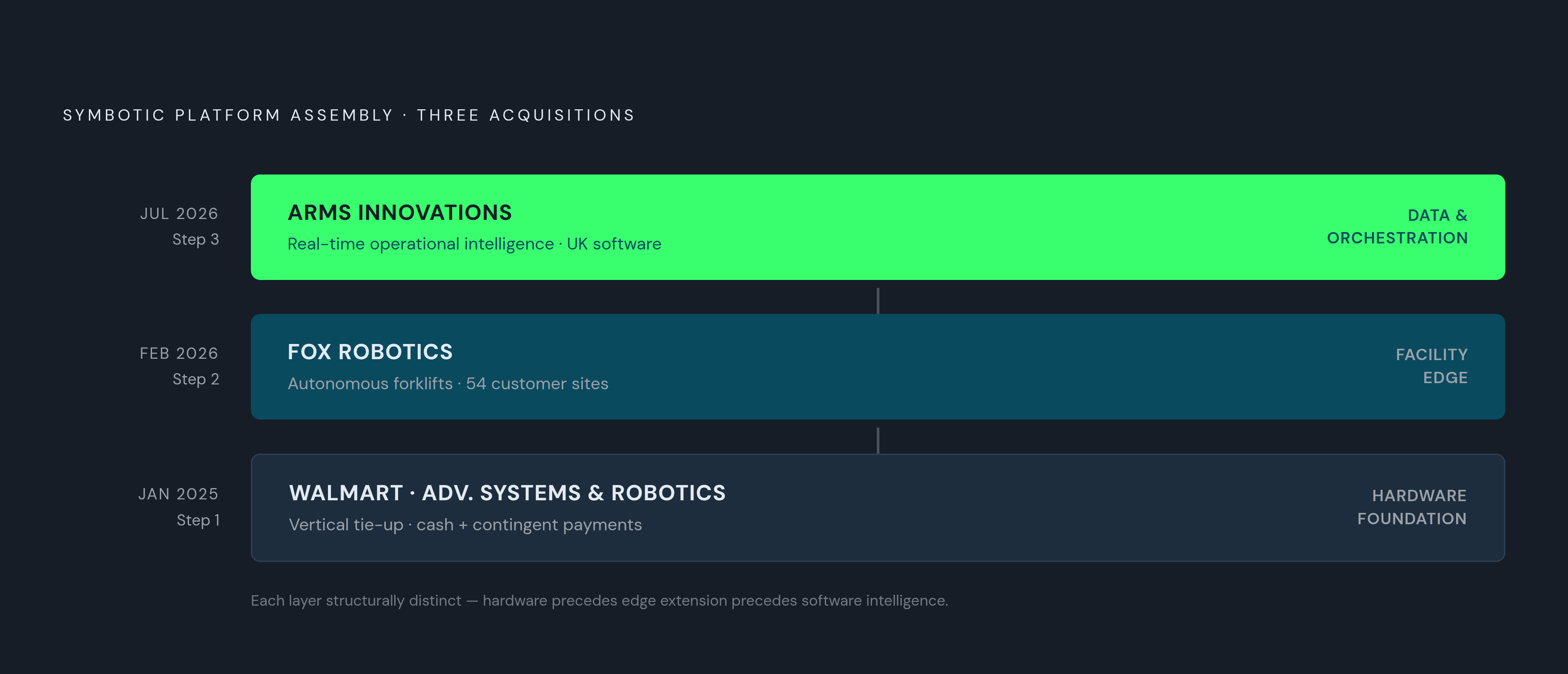
Consolidation moving up the stack from hardware to software
The earliest wave of this consolidation was built almost entirely from hardware. Companies bought mobile robots, manipulation arms, forklifts, and fleet operators so they could cover more of a physical workflow with equipment they owned. The deals closing more recently point somewhere else. Schneider Electric's purchase of PTC, Qualcomm's entry into manipulation middleware through PickNik, and Symbotic's acquisition of ARMS Innovation all move the contest up into software, data continuity, and the layer of intelligence that coordinates hardware.
The Schneider Electric and PTC deal states this shift most clearly. When design data links to shop-floor execution, design data, simulation, regulatory compliance, and operational maintenance start to live inside one managed system. The system now simply assumes the hardware underneath it. The data fabric connecting design to operation is what differentiates one platform from another. Qualcomm's acquisition of PickNik carries a semiconductor company directly into robotics middleware: by folding PickNik's capabilities into the MoveIt framework, Qualcomm positions its own silicon as the natural foundation for manipulation planning, a vertical integration that runs from the chip up through the motion plan a robot executes. Symbotic's purchase of ARMS Innovation does the equivalent work on the warehouse floor, because it adds real-time operational intelligence on top of a physical platform that already included Walmart's Advanced Systems business and Fox Robotics. That software layer is what turns a collection of robots into a managed, coordinated system rather than a set of machines operating independently of one another.
The direction of travel matters for anyone buying automation today. Differentiation that used to live inside individual robot hardware, the quality of a gripper or the reach of an arm, is migrating into the software and data layer that coordinates many robots at once. A procurement decision made in 2026 locks in a data architecture as much as it locks in a piece of equipment, and the vendor that owns that architecture holds far more leverage over the buyer's future options than a hardware vendor ever did.
Platform consolidation for buyers: integration depth versus switching cost
Buyers evaluating automation now face a trade-off that did not exist in the point-solution era: how much integration depth a platform offers against how expensive it becomes to leave that platform later. A single-capability vendor was easy to replace, because its product occupied one narrow slice of a workflow and swapping it out meant touching one integration, not an entire operation. A platform built from stacked acquisitions, the way Symbotic layered Walmart's Advanced Systems business, Fox Robotics, and ARMS Innovation on top of one another, or the way SoftBank intends to combine ABB Robotics with Berkshire Grey, AutoStore, Agile Robots, and Skild AI, offers far more integration depth. It also raises the cost of leaving substantially, because the data architecture, the orchestration software, and the physical equipment are no longer separable the way they once were.
This does not make platform consolidation something buyers should avoid. A genuinely integrated system solves real operational problems that a collection of point solutions never could, coordinating perception, navigation, manipulation, and fleet management inside one coherent architecture instead of across five vendor contracts and five support lines. Qualcomm kept MoveIt open-source after it acquired PickNik, showing that at least one major acquirer recognizes that switching vendors becomes costly once systems are locked together, and chooses to mitigate that by treating openness as a competitive advantage. Buyers evaluating any platform assembled through this wave of M&A should ask a direct question before signing a multi-year contract: which parts of this system remain portable if the vendor relationship ends, and which parts, the data format, the orchestration layer, the fleet management software, become permanent fixtures of the buyer's own operation. The answer to that question, more than any feature comparison, determines what a platform actually costs over its lifetime.
Notes
- Serve Robotics Inc. /DE/ - Form 10-Q - FY2026
Provided details on Serve Robotics' acquisition of Diligent Robotics, including the January 27, 2026 closing date and description of Diligent as an AI-powered robot assistant provider for healthcare.
- Skild AI Acquires Zebra Technologies’ Robotics Automation Business
Provided the basis for the discussion of Zebra's divestiture of its robotics operations to Skild AI, illustrating how one company's periphery became another's foundation.
- Top 5 Global Robotics Trends 2026 - International Federation of Robotics
Supported the article's framing of robotics industry trends including the shift away from narrow single-capability vendors toward integrated platform solutions.