ISO 10218 vs ANSI RIA R15.06 for Industrial Robot Safety Compliance
R15.06 Part 3 covers operator responsibilities where ISO 10218 leaves a structural gap.
Two industrial robots, one bound for a plant in one country and one bound for a plant in another, can roll off the same assembly line and still owe their compliance paperwork to two different documents. The architecture behind ISO 10218 and its American counterpart, ANSI/A3 R15.06, is one technical core expressed at two levels, with a third piece bolted onto the American version that has no equivalent anywhere else in the world. That third piece is not a bureaucratic accident, and treating it as one is the most common mistake operators make. It exists because of a structural gap in who ISO standards are written for, and closing that gap is the only way to figure out which requirements actually govern a given robot cell.
Why two standards exist for the same subject
Robot safety at the international level runs through ISO 10218. In one country, it runs through R15.06, published by an industry robotics association, now folded into a broader automation trade group. These are not competing philosophies about how to keep people safe around robots. Parts 1 and 2 of R15.06 are the national adoption of ISO 10218, with the technical content drawn directly from the ISO original.
The reason a separate American standard needs to exist at all comes down to who ISO writes for. ISO 10218 is structured around suppliers, meaning robot manufacturers and the integrators who build cells around them. Its coverage of the people who run those cells day to day, shift after shift, once the integrator has packed up and left, is limited by that supplier focus. That structural gap is the reason R15.06 carries a Part 3 that ISO does not have.
Canada runs a parallel track. CSA publishes Z434, its own national adoption of ISO 10218 Parts 1 and 2, with Canadian deviations layered on top. It's a North American habit, taking one international document and localizing it twice: once for the United States, once for Canada.
How the standards evolved to their current form
ISO 10218-1 came first, in 2006, aimed at the robot itself: how manufacturers design in safety before the machine ever leaves the factory floor. ISO 10218-2 followed in 2011, shifting the focus downstream to system integration: installing the robot, safeguarding the cell around it, running it, eventually decommissioning it.
RIA folded both parts together into a combined R15.06 edition, and that combined standard held the field in the United States for almost fifteen years. Fifteen years is a long stretch for a document governing a technology that moved as fast as industrial robotics did over that period. The technology underpinning safer robot integration continued to advance rapidly over that period, and the standards governing it had not kept pace.
The rewrite that produced the 2025 editions took experts from more than twenty countries close to eight years to finish. That timeline rules out a simple grammar cleanup or a renumbering exercise. An effort that long, with that much international participation, only makes sense if the standard is being rebuilt around genuinely new technical ground.
What each part covers and who it obligates
ISO 10218-1, mirrored in R15.06 Part 1, sets requirements on the robot as a piece of machinery, covering inherently safe design choices, the protective measures built into the hardware, and the information the manufacturer has to hand over about how the thing is meant to be used. This is the manufacturer's document, and it applies before an integrator has even touched the robot.
ISO 10218-2, mirrored in R15.06 Part 2, picks up from there. It covers the robot application, the cell as installed: how it's safeguarded, what the risk assessment looks like, how it's meant to run once it's live. This is the integrator's document.
R15.06 Part 3 has no ISO counterpart, and that absence is the point, not a footnote. It's written for the end user, the company running the robot cell on its own production floor, and it fills the gap that ISO's supplier-focused structure leaves open by design. Part 3 also carries explanatory material on sections of the ISO-derived text that practitioners have found useful for applying the requirements in practice.
Where ISO 10218 and R15.06 are technically identical
Parts 1 and 2 of R15.06 adopt ISO 10218-1:2025 (Edition 3) and ISO 10218-2:2025 (Edition 2) directly. The technical requirements in those parts are drawn from the ISO text through the national adoption process, without independent reengineering of the underlying content. Every major technical change in the 2025 revision flows through both standards at once, through that adoption mechanism, whether the reader notices or not.
Functional safety requirements got explicit where they used to be implied. The old standards leaned on Performance Level d and Category 3 as an unstated default. The 2025 editions replace that with stated default performance levels, with room to deviate based on a documented risk assessment instead of a blanket assumption. Robots now get sorted into Class I and Class II, based on total mass, maximum force, and maximum speed. Class I covers robots that don't pose much of a hazard and is generally Performance Level b. Class II, the stricter tier, covers most industrial robots actually on the market, and it requires speed to be safely monitored in T1 and teach mode.
Collaborative robots, as a category, are gone, and the standard is sharper for it. The 2025 text talks instead about collaborative applications (any application containing at least one collaborative task) and collaborative tasks (the portion of a robot's sequence where the robot and a human operator share the same safeguarded space at the same time). That distinction stops people from calling an entire cell "collaborative" when only one motion in the cycle actually is, which was always a marketing habit more than an engineering one.
ISO/TS 15066:2016, the technical specification that handled power-and-force-limiting collaborative work, has effectively been absorbed. It hasn't been formally withdrawn, but its substance now lives mostly inside ISO 10218-2, with pieces reflected in Part 1 too. The four collaborative operation modes (monitored standstill, hand guiding, speed and separation monitoring, power and force limiting) survive in substance, restructured into the new document. Compliance testing for power-and-force-limiting robots is no longer optional or ambiguous: integrators claiming Part 2 compliance with a PFL-mode robot have to run the test.
The treatment of safeguarded space was updated in the 2025 revision, in ways that accommodate cells mixing collaborative and non-collaborative work in the same footprint. Cybersecurity appears as a safety requirement for the first time, covering authentication, data protection, and software update protocols, subjects the 2012 editions never touched. Guidance that used to live in separate technical reports, ISO/TR 20218-1 on end-effectors and ISO/TR 20218-2 on manual load and unload stations, is folded into the main text now instead of scattered across three documents an engineer had to track down separately. The vocabulary shifted too: "safety-rated monitored stop" is now "monitored standstill," and the standard talks about "robot application" rather than "robot system," a small phrase change that reflects a bigger one, since application now explicitly includes the workpiece, the task program, and whatever supporting equipment sits in the cell.
Because Parts 1 and 2 are direct adoptions, a manufacturer that meets ISO 10218 meets the substance of R15.06 Parts 1 and 2 by the same act, no extra engineering required. The divergence between the two standards doesn't live in the technical content. It lives entirely in Part 3, and in how each region enforces the document once it's written.
Where R15.06 goes beyond ISO 10218
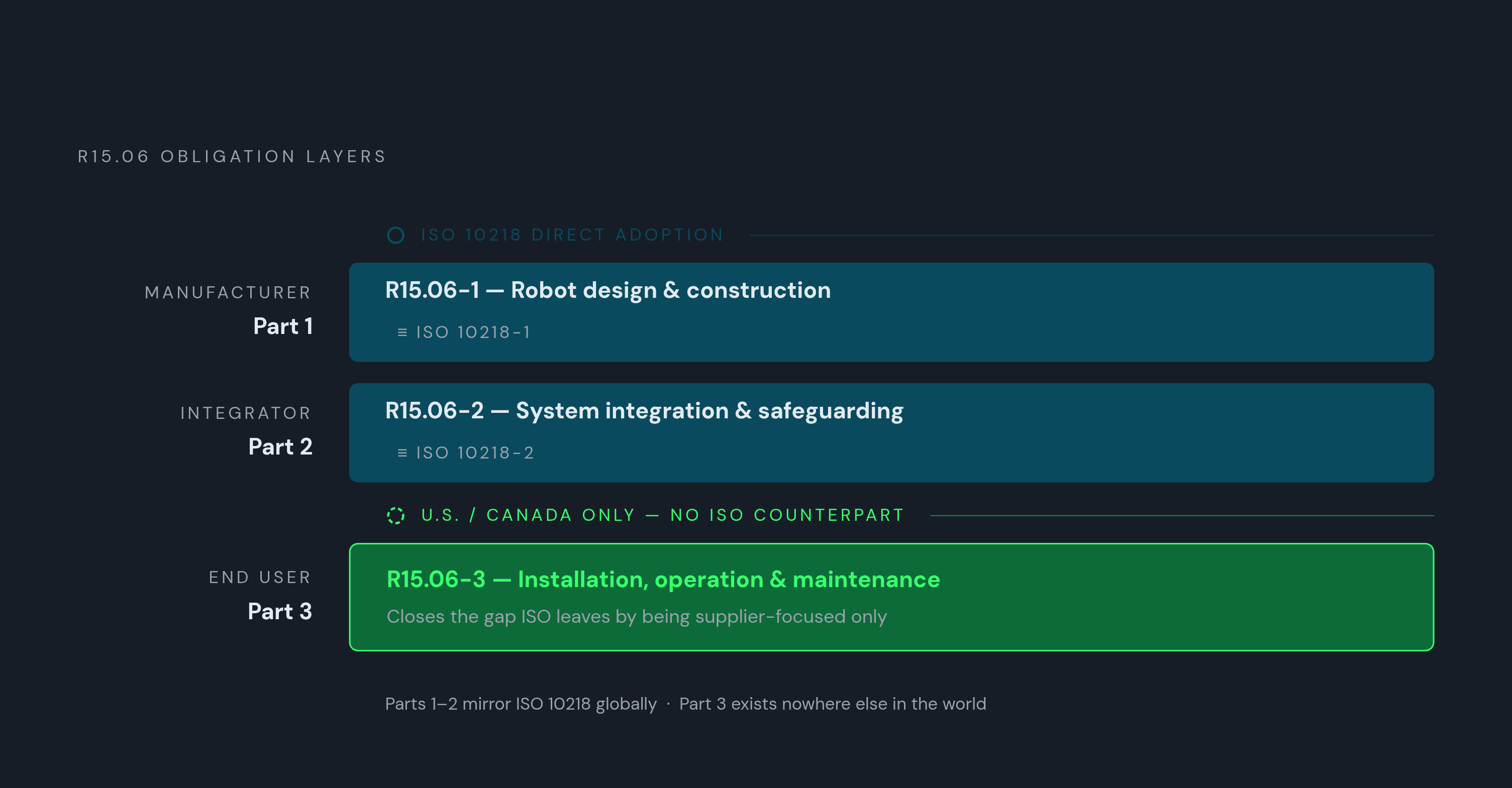
Part 3 is the whole story here, and anyone who treats ISO 10218 compliance as sufficient for operating in the American market has missed the point of the document. Part 3 was written in the United States, with input from Canadian standards experts, and it has no ISO counterpart and no real international analog. Nothing in ISO 10218 addresses the end user directly, because ISO machine safety standards, as a category, are written for the people who supply equipment, not the people who run it for the next fifteen years.
Part 3 closes that gap. It sets requirements aimed specifically at users of robot systems, robot cells, and robot lines, meaning people whose job is operating equipment somebody else designed and installed. It layers in explanatory material on the ISO-derived sections of Parts 1 and 2 that practitioners have flagged as unclear. And it covers ongoing operation in a way ISO 10218 mostly doesn't from the user's side. Installation gets plenty of attention in the ISO text. What happens in year three of running the cell, after the integrator's warranty has expired and the original risk assessment is gathering dust in a filing cabinet, gets comparatively little.
The practical consequence is direct, and it's the part compliance teams miss most often. An end user running a robot cell carries obligations under R15.06 that don't exist anywhere in the ISO text. Building to ISO 10218 alone does not get an operator to full R15.06 compliance, if that operator is the one running the equipment rather than the one who built it. Assuming otherwise is the single most expensive misreading of these two documents.
How enforcement differs between the U.S. and EU contexts
OSHA has no robot-specific regulation on the books, and it never has. Enforcement in the United States runs through the General Duty Clause, the catch-all provision requiring employers to keep the workplace free of recognized hazards. Once a new standard supersedes an old one, it becomes the benchmark for what a recognized hazard looks like in an inspector's eyes. R15.06-2025 functions as the practical reference standard for new work, even though OSHA never wrote a rule saying so directly.
No mandatory transition window has been publicly identified in this system, and no such window has been announced by OSHA. An existing installation that met the prior standard doesn't get automatically reopened or flagged for retrofit. For new installations and significant modifications, working to the current editions is the prudent course. Anyone doing otherwise is taking a risk if an inspector or a plaintiff's expert checks which standard governed the work.
The EU runs a more formal version of the same idea. The Machinery Directive, 2006/42/EC, is the current legislative anchor, transitioning to the Machinery Regulation, 2023/1230, effective January 20, 2027. EN ISO 10218-1:2025 and EN ISO 10218-2:2025 were published in the Official Journal of the European Union as harmonized standards under the Directive on September 7, 2026. Existing CE certificates issued under the 2006/42/EC framework stay valid until the January 2027 cutoff, at which point anything placed on the EU market has to comply with the new Regulation instead.
Harmonized status buys a manufacturer in the EU a presumption of conformity: build to the harmonized standard, and the law presumes the machine meets the legal safety requirement, no further argument needed. Nothing in the American system works that cleanly, and pretending otherwise is a mistake that appears in litigation, not in a compliance audit. OSHA doesn't mandate R15.06. Compliance with the standard is voluntary, not a legal presumption of conformity in the way harmonized EU standards operate. Same underlying technical document, two very different legal postures wrapped around it.
For a manufacturer selling into both markets, the hardware doesn't need to change. A machine built to ISO 10218 satisfies R15.06 Parts 1 and 2 on the technical merits, and vice versa. What changes is the paperwork: the compliance demonstration, the documentation trail, and the conformity assessment process, all running on separate tracks depending on which market the robot is headed for.
Standards governing a given operation
Start with the role. That decides which parts of which standard apply, before geography or timeline enters the picture. A manufacturer's obligations sit in Part 1. An integrator's sit in Part 2. An end user in the United States or Canada picks up Part 3 obligations that a manufacturer or integrator never has to think about.
From there, geography matters. Selling or deploying in the United States means working to R15.06-2025 in full, all three parts as applicable to role, with Parts 1 and 2 drawn from the ISO original through national adoption and Part 3 layering on the user-specific pieces that ISO doesn't touch. Selling into the EU means working to ISO 10218:2025 as a harmonized standard under the Machinery Directive or, after January 2027, the Machinery Regulation, following the CE marking pathway, with no Part 3 equivalent anywhere in that process. Operating in Canada means working under CSA Z434, which adopts the same core content under its own national deviations. Selling into several jurisdictions at once means the technical core stays shared, but the documentation and the user-obligation layer have to get planned for separately, from the design stage onward, not bolted on after the fact when a customer's legal team asks for it.
Installation status is the last variable, and it's the one people get wrong most often. A new installation, or a significant modification to an existing one, needs to be built to the 2025 editions on both sides of the ocean: R15.06-2025 in one country, ISO 10218:2025 in the EU. An existing installation doesn't get automatically reopened just because the standard changed underneath it. But the 2025 text becomes the reference point the moment anyone has to argue, in an OSHA proceeding or a European conformity review, about what a recognized hazard looks like now, not in 2012.
Both documents are available directly, and buying the wrong one wastes money nobody on a compliance budget wants to waste. ANSI/A3 R15.06-2025, all three parts, runs 403 pages and costs $655 USD through A3. ISO 10218 Parts 1 and 2 are available through A3 starting at $244.
Sources
- News: Updated ISO 10218: Major Advancements in Industrial Robot Safety Standards Now Available
- Behind the ISO 10218 series safety standards updates in 2025: understanding the real-world shifts in industrial robot technology that drove the revisions (article 2 of 2) | IDEC USA
- therobotreport.com
- A3 releases full three-part national safety standard for industrial robots - The Robot Report
- Robotics - Standards | Occupational Safety and Health Administration
- automate.org